Sunday, January 22, 2006

Why critical consumption is not a common consumer behaviour?


If we believe that:
- as consciousness beings we make consciousness choices;
- we should take responsibility for the choices we make;
- our choices impact other people, environment, society, etc;
- although impact resulting from each individualistic behavior is relatively microscopic, the combined effect of these behaviors is significant;

Why then those who think before they buy are still a minority? How many people, base their choices mainly on financial or brand criteria or consume only because are influenced by an intrusive advertisement?
Why is not “ethical” or “critical” consumption a natural choice?

Reasons are many…..

- Are we indeed consciousness beings? How many things we do, are done because we follow a certain pattern, automatically, subconsiously learnt? If we study ourselves we might find that the reasons why we drive our car to go to the shop or the fact we take the plastic bag graciously given by the shop-attendant do not include at all consideration about the impact on nature. Not necessarily does this mean that we do not care about nature…sometimes we simply have not thought about the side effect of our activities.

Another common reason for rejection is people do not believe that "critical" or "ethical" consumption could lead to meaningful result due to the negligibly small impact of each of us over the “entire” world. Many people would think critical consumption is nice, but they claim is inefficient and useless due the difficulty to involve a critical mass in it.

However a simple way to defend the contra thesis is if we draw a parallel to political elections and voting. During election campaigns, there is significant investment from the elite, advertising to citizens the importance of each individual vote. The results of an election are a visual example of the impact of combined effect of individual behaviors…then why is so difficult to accept the fact that if 60% of dog owners start to clean the shit after their dogs there will be at least 50% less shit on the street. (accounting for street dogs)

There others who entirely reject critical consumption. It is their understanding that the state and municipalities have to regulate environmental and ethical issues. They do not want to invest time, money and efforts in critical consumption. They are convinced that their social responsibilities end when they pay their taxes if they do. It will be a long way to get these folks involved, but lets try to change ourselfes first....

This blog is trying to aggregate reasons why individual choice matters and to help critical consumers in their behaviour through providing useful information. Comments on how we do it are more than welcome!

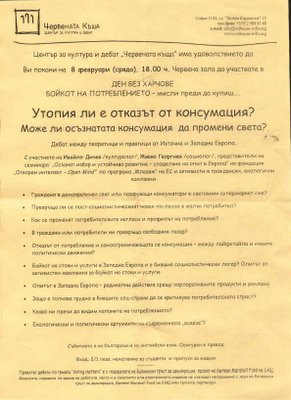
Public Debate at the Red House

February 8 (Wednesday), 6.00 p.m.
The Red House Centre for Culture and Debate, Red hall
Buy Nothing Day- special Bulgarian edition.

Critical consumption – real impact or still a dream?
Debate: theoretical and practical views

With the participation of Ivaylo Ditchev (cultural anthropologist), Jivko Georgiev (sociologist), radical activists and representatives of the seminar "Critical consumption and sustainable development; sharing experience in Europe" of Open Mind Foundation in"Youth" Programme, EC.

The event is in English and Bulgarian.Tickets: 2/1 BGN


Monday, January 09, 2006

Seminar Programme

Critical Consumption & Sustainable Development
3rd - 9th of February 2006
Sofia, Bulgaria
European Commission – “Youth” Programme – Action 5

3rd February - Friday
Arrival of participants in Sofia
and settlement in Be My Guest Hostel

4th February – Saturday
Morning - Plenary session at the Red House
Presentation of the project
Presentation of the associations - (5 min each)
Afternoon: Plenary Session:
Market of good practices
Analysis of prep work - 15 min each
(Each delegation will prepare a sort of “stand” with
products, books, brochures, posters, photos or whatever other materials realised in their community)
Media available for presentation purposes:
media projector, DVD player + big screen, possibl TV+ Video player

Evening: intercultural evening at BMG (tbd)

5th February –Sunday
Morning: Working Session: breakout groups
Participants will work in 3 "breakout" sub-groups each working on specific problem/topic. Each group will work with a moderator to support problem-solution oriented debate.
Afternoon: Working Session: breakout broups

6th February - Monday
Morning: Field Visit
Meeting with Integra, NGO running 10 Senses Fair Trade shop
Afternoon: Working Session: breakout groups in progress.


7th February – Tuesday
Morning: Field visit:
Meeting with Bulgarian NGO “Za Zemiata” (For Earth) – (tbc)

Afternoon: Working Session:
-breakout groups
-Field Visit: EcoBulpac, (а non-profit JSCo, consortium of 55 companies investing in sustainable separate garbage collection systems and recycling)
Evening: at Su - Working Session - Project Data Bank
(Developing ideas and proposals for future projects in the Youth Program framework on the topic of Critical Consumption and sustainable development)
8th February –Wednesday
Morning: Plenary Session: -
- Presentation of the results from facilitation breakout groups in plenary.
- Preparation for the public debate
Afternoon: Free time
Evening: Public Debate at the Red House
9th February - Thursday
Working Session at BMG: Final evaluation
Departure of participants
If not specified different working sessions will be held at "Apartmental" at 68, Neofit Rilski St